|
Paul Touvier |
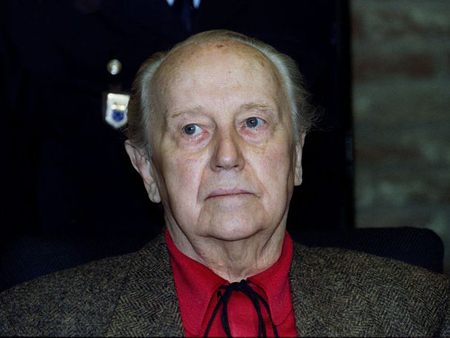
Who Was Paul Touvier? When in his childhood years he longed to become a priest, Paul Touvier never imagined he would become the first Frenchman to be convicted for crimes against humanity 50 years later. Born in Southern France, in in Saint-Vincent-sur-Jabron, Paul Touvier was raised in a Catholic and lower middle class family. The son of Eugenie, a very religious woman, and François, a tax collector, Paul grew up in a very conservative house. His family vehemently opposed to the anti-clerical legislation promulgated by the Third Republic. In 1936, Touvier joined the extreme right-wing Parti Social Francais, already showing his anti- Semitic prejudice, and by 1939, while working as a clerk at the local railroad station he joined the French Army's 8th Infantry Division, Touvier fought against the German Wehrmacht until, following the bombing of Château-Thierry, he was injured. At his return to France, Touvier joined the newly created Legion Francais des Combattants, a servicemen's organisation which was designed to propagate Vichy's National Revolution. Now His life took a new course in 1943 after the Milice was established. Quickly rising among his fellow Milice comrades, Touvier came to the attention of the inspectors from Vichy, who in September 1943 sent him to Lyons to be regional director after his qualities recruiting informants and tailing suspects were widely noticed. His success in the right-wing movement continued to be remarkable and “he became head of the intelligence and operations sections of the Milice in Savoy, and then in the Rhone, where he worked alongside Klaus Barbie, "the butcher of Lyons". Touvier soon earned a similar sobriquet, "the hangman of Lyons", and in January 1944 was involved in the murder of Victor Basch, the former president of the Human Rights League which in the 1890s had rallied to the defense of Dreyfus, the Jewish army captain falsely accused of treason,” as is noted in the obituary wrote in The Independent after his passing. Touvier caused fear amongst the Jewish community and was notorious for his racketeering. He would promise protection to them at a price, but instead took their apartments and proprieties of those he turned to the cells. The Jewish people called it theft, he called it requisitioning, always arguing that his actions were never illegal. After the liberation of France, Touvier went into hiding. He escaped the summary execution suffered by many suspected collaborators and in September 1946, the French State sentenced him to death in absentia for treason and collusion with the Nazis. Touvier found a way to escape by hiding in religious buildings. He went to Montpellier, in the south of France, and bought a boarding house ran by nuns. After selling the building, he went to Paris and found shelter in a convent while Monsignor Charles Duquaire, secretary to the Archbishop of Lyons, began gathering information and advocating a pardon for Paul Touvier. After the church’s lobby for pardon for many war criminals, amongst them, Paul Touvier, President granted it. The pardon caused a public outcry, especially among veterans of the French Resistance and the nation's Jewish community and in 1973 Georges Glaeser filed a complaint against Touvier in the Lyon Court, charging him with crimes against humanity. After many years on the run, hiding with help of traditionalist Catholic religious communities and sympathizers, Paul Touvier was arrested on May 24, 1989, in a Society of Saint Pius X Priory in Nice. After his capture, a jury found him guilty for his crimes and was sentenced to life imprisonment. On July 17, 1996, Paul Touvier died at age 81 of prostate cancer in Fresnes Prison, the same prison which during the Nazi Occupation witnessed the torture and execution of many resisters to the new regime. |