|
|
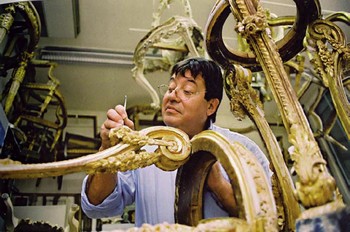
The French Master Craftsmen Director:Josée Dayan Not generally known to the public, the makers of art objects in France enjoy a huge reputation among the world's connoisseurs. It is in France you find the best glass artists, the most brilliant silversmiths, the greatest finery makers, the most skilled embroiderers and the finest organ makers. There are 50 of these "maîtres d'art" (art masters, a title bestowed for life), that have been blessed with the talent of preserving theserare gifts from generation to generation. Catherine Deneuve is our spokeswoman, guiding us on a voyage of discovery as we get to know the last of these very secretive grand masters Ep. 1 Carved, Gilt Wood Once upon a time, there was carved furniture. These patiently crafted "objects d'art" spread through France as early as the 16th century due to Italy's creative influence. Of course, King Louis XIV made sure he established a French style of gilt furniture. Over the years, France has proved its expertise to such an extent that the last few remaining craftsmen are now inundated with orders from all over the world, not to mention from collectors and antique dealers. With Bruno Desnoues and Jacques Goujon Ep. 2 Furnishings Furnishings - such as fringes, rosettes, woven or braided items - have been used on clothes since earliest antiquity in Assyria and Egypt. Then, they conquered Byzantium, the Mediterranean region, Italy, and finally, France. They have been adopted, developed, and enriched everywhere. In the 18th century, French soft furnishings acquired an unparalleled creativity and refinement. They reached their peak under Napoleon III. Furnishings fell dormant at the start of the 20th century, then found fresh inspiration in art deco. Interest in them was renewed about thirty years ago thanks to the restoration of historical monuments. With the maisons de passementerie Declercq Passementiers Ep. 3 Cabinet-making The word "cabinet-making" first appeared in the Académie Française dictionary in 1732 and refers to the art of the cabinet-maker, a craftsman in decorated furniture-making. The art includes the techniques of carpentry as well as veneering, marquetry, and making board games. With Henri Desgrippes and Michel Germond Ep. 4 Bronze Furnishings Used in times gone by in the making of weapons, of gold and silver tableware, and in the decoration of churches, gilt bronze found a new application during the reign of Louis XIV, particularly in the embellishment of wooden furniture. France still has a few remarkably talented bronze-smiths who work just as their 18th-century ancestors did. With the maisons Amaury, Mathieu and Daniel Couste Ep. 5 Sèvres China French bone China dominated the 17th and 18th centuries. The many porcelain factories have now disappeared. Only the Sèvres factory, founded by Louis XV, continues to make everything entirely by hand, thereby ensuring the continuity of its prestigious past. This site, which now belongs to the State, perpetuates 18th-century techniques both in terms of the reproduction of old pieces and the creation of new works by contemporary designers. With the manufacture nationale de Sèvres Ep. 6 Lacquer 4,000 years ago, the Chinese invented this very shiny black or red varnish - lacquer - by making use of the properties of the sap from coniferous trees: as it dries, the gum becomes a stable protective coating. Nowadays, the lacquer is replaced by synthetic ingredients. The art of working with this substance is meticulous and still uses the same ancient techniques. Lacquer is the term used for this art form as well as the objects coated with this varnish. With Roland Ingert and Elie Assouline. Ep. 7 Gold & Silver Tableware Terrines, fruit bowls, saltcellars... French gold and silver tableware came into its own during the reign of Louis XIV. Then, in the 18th century, it became decorative and thrived in a masterfully elegant 'rocaille' style which was the envy of all the courts in Europe. But France was unable to conserve this heritage due to dispersal and the royal and revolutionary foundries. It rose from its ashes under the Empire. During the last century, Art Nouveau renewed the genre, followed later by Art Deco. With Nicolas Marischaël and Gérard Morisot Ep. 8 Lorraine Crystal Lorraine has had a tradition of glass-making since the 15th century. In the second half of the 18th century, the Cristallerie Royale de Saint Louis ("Saint Louis Royal Glassworks"), then the one in Baccarat were set up to rival imports from Venice and Bohemia. They surpassed their competitors in terms of creativity and refinement. The 19th century saw the golden age of crystal glass-making in Lorraine. With the cristalleries Baccarat and Saint-Louis Ep. 9 Silk from Lyon With its embroidered fabrics, refined hangings, golden brocades, and cut velvet, Lyon's silk-making trade reached its peak in the 18th century. It still makes genuine masterpieces today. From the Renaissance on, Lyon was an active high-quality production centre whose compositions decorated the castles of France as well as princely dwellings all over Europe. Now, Tassinari-Chatel and Prelle are the two houses which have inherited this prestigious past. With the manufactures Prelle and Tassinari-Chatel Ep. 10 Fine Clock-making The Enlightenment represents the golden age of French clock-making and it lasted until the days of the Empire. For almost a century, French craftsmen made fine, elegant clocks with eccentric shapes and designs, signed by reputed cabinetmakers and bronze-smiths. With Philippe Prutner and Jean-Claude Gendrot
|