|
Sidonie-Gabrielle Colette |
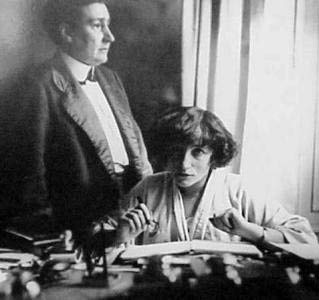
Colette: A True Heroine Scandalous. Revolutionary. Determined. These are just a few of the words used to describe the French sensation Sidonie-Gabrielle Colette. Her unique character and one-of-a-kind strength made her one of the most exceptional and controversial authors to come out of Europe in the early 20th century. Despite her salacious reputation, she was a leader of the feminist and freedom movements, a beacon of light in a drearily conservative time. Colette’s early years are shrouded in mystery. What is known is that she was born in January of 1873, her father a retired Captain, her mother a well-educated lover of the arts. Thanks to her parents, Colette was introduced at an early age both to the rich world of Belgian art, and the clandestine arena of politics. Her story truly begins at the tender age of 20, when she married Henri Gauthier-Villars, a bisexual man known for both his rapier wit, and his connections to the Parisian underworld, where he was known simply as “Willy.” Her new husband was fifteen years older than her, but he saw right away that his young wife was no pushover, and so he immediately sought to nurture her wit and intellect. |

|
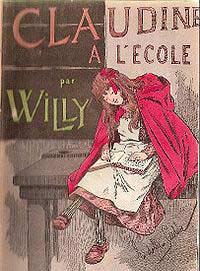
He encouraged her to write, giving her the opportunity to publish her work under his name; a rare opportunity for a woman in the 1900s, as the fairer sex was forbidden from publishing literature of any kind. Her first major work was a collection known as the Claudine novels, a body of work that some sources say was written under intense pressure. Willy was no gentle mentor: he would, the legend goes, lock his wife away in her room for hours until she was able to produce the top-quality work she would later become famous for. Colette’s work was dripping with sexual energy, much of which was taken directly from her own life story. Her bisexuality was a hot topic in the Claudine books, which broke new literary ground. Claudine at School was the first novel in modern literature to address lesbian romance: the 15-year-old protagonist develops an uncontrollable crush on her own female assistant. Colette, despite her marriages and numerous male lovers, always had a soft spot for girls, especially the beauties of Paris. |
Claudine at School |
|
Collette & Monsieur Belboeuf |
Paris was good to Colette, who first broke onto the scene in 1900 with her many performances on the Parisian stage. Through her work she enjoyed close relationships with the most renowned personalities in high society, taking friends and lovers from the highest halls of power. This allowed her to entertain affairs with the infamous Mathilde de Belobeuf, better known as “Missy” to her loved ones and “Monsieur Belboeuf” in Paris’s lesbian underground. History, however, would know Mathilde by a different title: the niece of Emperor Napoleon III. Her taste in girls was not the only thing that caused scandal. She invited further controversy in 1906, when a photograph was taken during a theatrical performance, during which she exposed one of her breasts. The accidental wardrobe malfunction shocked and titillated people all across the world, starting an international controversy and presenting a new, wholly unexpected challenge to the traditional gender roles of French society. This little slip up paved the way for the women’s liberation movement. |
|
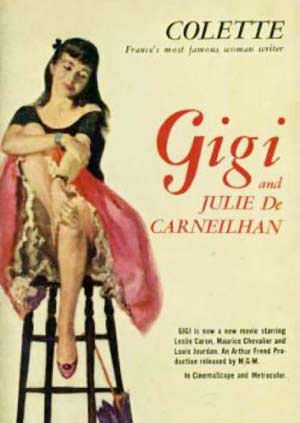
The true source of controversy, however, was always Colette’s work. Despite the salacious plots, scandalous reception, and wounded sensibilities of uptight readers, her novels became a sweeping commercial success, leading to a franchise of produces related to her books: Colette’s writing spawned everything from a stage musical to a brand of perfume, from “Claudine” themed uniforms to “Claudine” themed soap. People even sold cigars branded with the title of the shocking yet acclaimed saga. Not even age could slow Colette down. At the age of 72, after three marriages and a lifetime of scandals, she published her most acclaimed novel ever: Gigi. This florid work would also spawn a franchise, later being adapted as a stage musical starring Audrey Hepburn, and to the silver screen in 1948, and then again in 1958 as a musical starring Leslie Caron. Colette died in 1954. She was mourned across Europe as one of the most important and influential writers of all time. Once again and even after her death, she revolutionized the world when she was given a French State funeral, a rare honor for a woman at the time. Return to Julie de Carneilhan |
Gigi |