|
The Haunted Castle |
A quick glance at European horror films history
When it comes to horror cinema, no-one seems to travel back in time and trace the very beginnings. In fact, few know that the first film of the genre dates back more than a hundred years. But which one was it? The world’s film pioneer Georges Méliès – a lover of fiction and illusion, and widely renowned for his groundbreaking film, A Trip to the Moon (1902), considered as the first science fiction made in history - broke the mold and made the first terror-horror film: Le Manoir du diable also known as The Haunted Castle (1896). |

|
As time passed, horror cinema spread throughout Europe and the next trend became German Expressionism between the first and second decades of the twentieth century. During those formative years, eager filmmakers such as Paul Wegener, Robert Wiene gained a reputation on the European circuit. Wegener’s, The Golem (1915) was his first success, adapting an old Jewish legend, while Wiene’s The Cabinet of Dr. Caligari (1920) turned into an avant-garde film for the era and became one of the most influential of German Expressionist films, often considered as one of the greatest horror movies of the silent era. The film is also one of the first introducing a twist ending and employ the use of flash backs in cinema. The mention of German Expressionism wouldn’t be complete without a pointing out the terrifying and popular Nosferatu (1922) by F. W. Murnau. Considered as a classic in its field, it is the first European vampire film and still offers today an outstandingly terrorizing performance by Max Schreck as the vampire Count Orlo. The film is an unofficial adaptation of Bram Stoker’s Dracula and its well-achieved production even spawned rumors about Max Schreck being an authentic vampire. |
Nosferatu |

|
Dracula |
During the 30s to mid 50s, horror films spread amongst Hollywood productions as European filmmakers focused more on creating war films, imitating their current social conditions. It was during the late 50s that Great British directors put their eyes back on horror and brought the genre back to life. During those days, themes like serial killers and super creatures took over the European horror screens with remarkable productions like Michel Powell´s Peeping Tom (1960), Terence Fisher’s The Curse of Frankenstein (1957) and Dracula (1958). Between the late 50s and the 70s, Italians flew the flag for horror-terror in Europe with a particular genre: Giallo. The genre was a response to the stereotypical American thrillers, but with more terrifying ingredients: crime, fiction, eroticism, and lots of blood. Amongst the most important directors of the genre are the infamous Dario Argento and Mario Brava. |

|
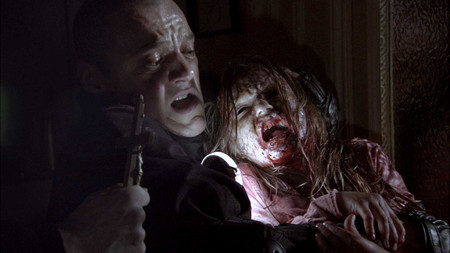
The genre went back into hibernation during the 80s and early 90s in Europe again, although since mid 90s, Spain and the Scandinavian countries have been leading a European horror cinema revival, with productions like Tesis, (1996) The Orphanage (2007), REC (2007) and Let the Right One In (2008). |
|
REC |